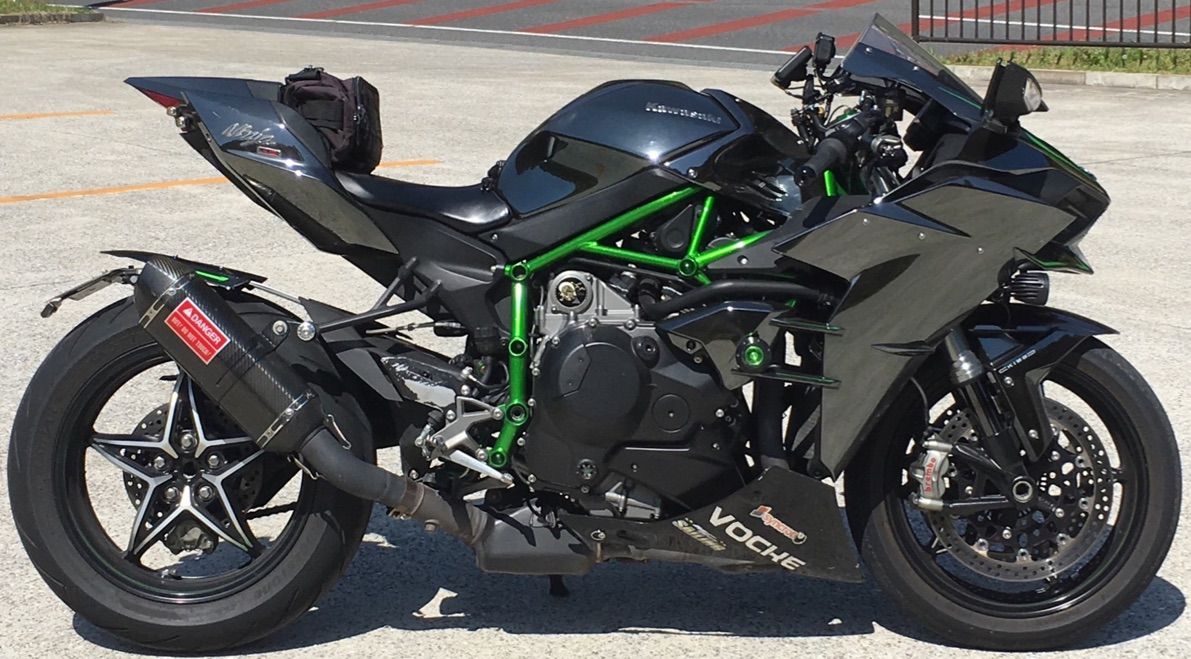
Kawasaki is bringing the Ninja H2 back for the 2027 model year with a long list of mechanical and electronic improvements. The famous supercharged sportbike keeps its distinctive 998cc inline-four engine, but much of the powertrain has been reworked for the new generation.
The road-legal Ninja H2 produces 200 hp at 11,000 rpm, with output increasing to 209 hp when the Ram Air system is operating. Maximum torque reaches 135 Nm at 8,500 rpm.
Alongside the standard Ninja H2, Kawasaki will continue the limited-production H2 Carbon. The track-focused Ninja H2R will also remain available, with power continuing to exceed 300 hp.
A Major Update for the Supercharged Engine
The basic engine layout remains familiar, but Kawasaki has made extensive changes beneath the bodywork.
The 2027 Ninja H2 still uses a liquid-cooled 998cc four-cylinder engine with Kawasaki’s centrifugal supercharger. However, the supercharger impeller and intake system have been redesigned.
Several internal engine components are also new, including the pistons, cylinder head, cylinders, crankshaft and camshafts. Kawasaki has additionally updated the throttle bodies and revised the transmission and final-drive ratios.
The focus of these changes is not simply maximum horsepower. Kawasaki says the revisions are intended to improve engine response in the low- and mid-range while retaining the strong acceleration that arrives as the supercharged engine climbs through the rev range.
209 HP With Ram Air
The headline performance figure remains 209 hp.
Under normal conditions, the Ninja H2 makes 200 hp at 11,000 rpm. With the additional airflow provided by the Ram Air system, maximum output rises to 209 hp.
The engine produces 135 Nm of torque at 8,500 rpm, giving the motorcycle substantial performance without requiring the rider to reach the highest part of the rev range.
2027 Kawasaki Ninja H2 Specifications
| Specification | Kawasaki Ninja H2 2027 |
|---|---|
| Engine | 998cc inline-four, supercharged |
| Maximum power | 200 hp |
| Ram Air power | 209 hp |
| Peak torque | 135 Nm |
| Power peak | 11,000 rpm |
| Kerb weight | 238 kg |
| Fuel capacity | 17 liters |
| Seat height | 825 mm |
Kawasaki lists fuel consumption at around 5.9 liters per 100 km and CO₂ emissions at 136 g/km.
Revised Exhaust and Six-Speed Transmission
The engine update also brings changes to the exhaust system. Kawasaki has modified the exhaust-pipe dimensions, redesigned the pre-chamber and altered the silencer to create a lighter overall system.
Power is sent through a six-speed gearbox using Kawasaki’s dog-ring transmission technology. A wet multi-plate clutch is paired with the Kawasaki Quick Shifter, allowing faster upshifts and downshifts without needing to operate the clutch lever.
Brembo Hypure Brakes Join the Ninja H2
The braking system is another important change for 2027.
The new Ninja H2 becomes the first Kawasaki model to receive Brembo Hypure front calipers. The radial-mounted four-piston monobloc units work with 330mm semi-floating discs.
At the rear, Kawasaki uses a 250mm disc with a two-piston Brembo caliper. The braking package is supported by Kawasaki’s intelligent KIBS anti-lock braking system.
The rest of the chassis retains the familiar high-performance setup. Up front is a fully adjustable 43mm KYB AOS-II inverted fork, while the rear uses an Öhlins TTX36 shock with a separate reservoir.
The bike has a 1,455mm wheelbase and weighs 238kg in running order, while seat height is set at 825mm.
Updated Electronics and Riding Assistance
Managing 209 hp requires sophisticated electronics, and Kawasaki has updated the Ninja H2’s electronic package for 2027.
An inertial measurement unit monitors the motorcycle’s movements and helps coordinate the various electronic systems during acceleration, braking and cornering.
The equipment includes Kawasaki Traction Control, launch control, power modes, engine-brake management, KIBS ABS and a two-way quickshifter. Cruise control and an electronic Öhlins steering damper are also included.
Riders can configure the available riding modes to adjust engine response and the level of traction-control intervention.
New TFT Display With Aviation-Inspired Graphics
Kawasaki has also refreshed the Ninja H2’s dashboard.
The motorcycle continues to combine an analog-style tachometer with a color TFT display, but riders can now choose between two different screen layouts.
One design takes inspiration from the motorcycle’s air-intake system. The other puts greater emphasis on the supercharger and uses aviation-inspired graphics to display information about the motorcycle’s position and lean angle.
Smartphone connectivity is handled through Kawasaki’s Rideology application, which can provide vehicle information, maintenance notifications and ride records. Some connected functions may vary according to the market.
Ninja H2 Carbon Returns
Kawasaki will once again offer the Ninja H2 Carbon as a limited-production version.
The Carbon model stands apart with a carbon-fiber-reinforced upper section of the fairing. Both the standard Ninja H2 and H2 Carbon are offered with the Mirror Coated Spark Black finish.
Kawasaki also continues to use self-healing paint on various exterior parts. Under suitable conditions, the finish can help reduce the appearance of certain light surface scratches.
Ninja H2R Remains a Track-Only Machine
The Ninja H2R is not disappearing with the arrival of the 2027 updates.
Kawasaki will continue producing the H2R for closed-course use. Its supercharged engine continues to deliver more than 300 hp, placing it above the road-legal H2 models in terms of outright performance.
Unlike the Ninja H2 and H2 Carbon, the H2R is not designed or approved for normal public-road use.
2027 Kawasaki Ninja H2 Price and Availability
Kawasaki has not yet announced the final Spanish price or exact Spanish delivery schedule for the 2027 Ninja H2.
In Germany, the announced prices are €33,050 for the standard Ninja H2 and €36,350 for the H2 Carbon. The H2R is listed at €58,550. These figures are market-specific and should not be treated as the final price for Spain.
European deliveries are expected to begin between late 2026 and spring 2027, depending on the model and market.
The Ninja H2 Keeps Its Unique Formula
The 2027 Kawasaki Ninja H2 does not attempt to reinvent the concept that made the model famous. Instead, Kawasaki has concentrated on improving almost every important area around its supercharged engine.
The revised powertrain, Brembo Hypure brakes, updated electronics, new dashboard and continued H2 Carbon option give the Ninja H2 a substantial refresh for 2027.
The central idea remains unchanged: a road-legal Kawasaki with a 998cc four-cylinder engine, centrifugal supercharging and up to 209 hp with Ram Air.
For the latest updates, follow takkyuudeuce

William Davis is a sports news reporter with over five years of experience covering sports news and events. He writes for Takkyu Deuce, bringing readers the latest game updates, player news, team stories, and other important developments from the world of sports.You can find him on Facebook
